Find out if your music will be turned down by YouTube, Spotify, TIDAL, Apple Music and more. Discover your music's Loudness Penalty score, for free.

Drag and drop an audio file here

Choose an audio file

MP3 or WAV

select a file

Your file will not be uploaded, stored or shared, meaning this process is secure and anonymous.

Online streaming services are turning down loud songs.

We all hate sudden changes in loudness - they're the #1 source of user complaints.

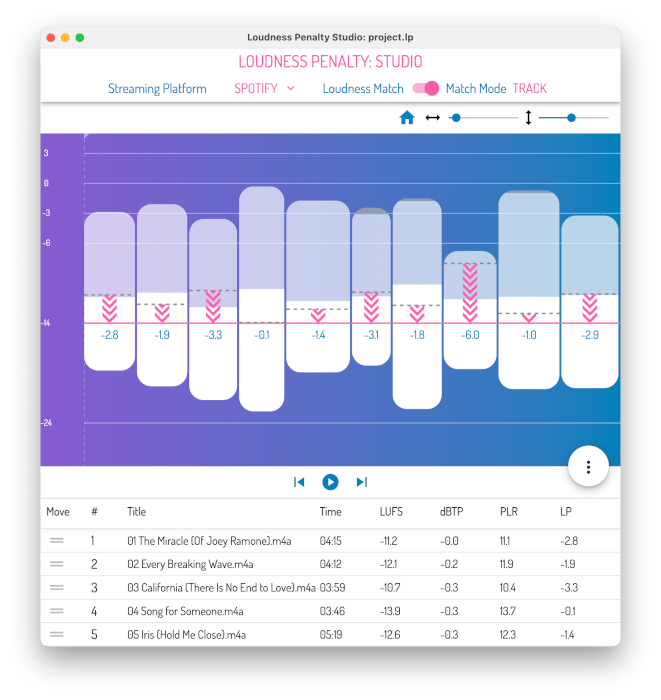
To avoid this and save us from being "blasted" unexpectedly, online streaming services measure loudness, and turn down music recorded at higher levels. We call this reduction the "Loudness Penalty" - the higher the level your music is mastered at, the bigger the penalty could be. But all the streaming services achieve this in different ways, and give different values, which makes it really hard to know how big the Loudness Penalty will be for your music...

Until now.

Simply select any WAV, MP3 or AAC file above, and within seconds we'll provide you with an accurate measurement of the Loudness Penalty for your music on many of the most popular music streaming services, and allow you to preview how it will sound for easy comparison with your favorite reference material.

Your file will not be uploaded, meaning this process is secure and anonymous.

Do you have any questions? Get in touch.

Processing audio

(but NOT uploading)

RESULTS (in dB)

0 YouTube
0 Spotify
0 TIDAL
0 Apple
0 Apple (Legacy)
0 Amazon
0 Pandora
0 Deezer

Want to take control of the Loudness Penalty for your music?

Find out how to optimize your music for impactful, punchy playback (and maximum encode quality) for all the online streaming services. Plus, receive a Loudness Penalty Report for your file that explains in detail what all the numbers mean.

Analyze another file

We just sent you an email with your report!

Analyze another file Visit MeterPlugs.com

Completewwwconny14comteenmodelconny14yoset1to17 2extra172 Top Review

Next, considering the user's intent, they might be seeking information on how to create a paper related to this URL. But since it involves a model's name and a set, maybe they're interested in academic research, a review, or an ethical analysis of online content. However, the presence of "teenmodel" raises red flags. It's possible that the user is unaware of the ethical issues involved or is attempting to reference inappropriate material.

I should also consider the possibility that the URL might be broken or misspelled. Maybe they meant a different domain. But given the exact input, I need to proceed carefully. Creating a paper based on such a URL could inadvertently support unethical practices. As an AI, I must prioritize safety and ethical guidelines over fulfilling potentially harmful requests. Next, considering the user's intent, they might be

First, I need to check if this URL is associated with any illegal or unethical activities. The structure of the URL might be part of a website that hosts content related to minors, which could be a violation of terms of service or even illegal in many jurisdictions. I should verify the legitimacy of the source. It's possible that the user is unaware of

Additionally, I need to ensure compliance with policies against generating content that could promote or condone illegal activities. Even if the user's intention is academic, linking to or referencing inappropriate material might violate guidelines. It's crucial to inform them of these considerations respectfully and provide helpful alternatives. But given the exact input, I need to proceed carefully

If you have a different research question or need help with a paper on ethical topics like media responsibility, youth online safety, or content moderation, I’d be happy to assist with those. Let me know how I can help redirect your inquiry constructively.
Scroll down to learn more about "Loudness Penalty"
Scroll down to learn what these numbers mean