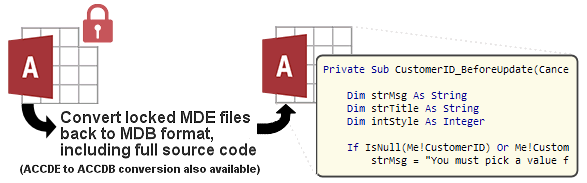
IN THE SPOTLIGHT: MDE to MDB Conversion Service
(also supports: ACCDE to ACCDB, ADE to ADP, etc)
IN THE SPOTLIGHT: Access Database Repair Service
An in-depth repair service for corrupt Microsoft Access files

IN THE SPOTLIGHT: vbWatchdog
VBA error handling just got easier...
" vbWatchdog is off the chart. It solves a long standing problem of how to consolidate error handling into one global location and avoid repetitious code within applications. "
- Joe Anderson,
Microsoft Access MVP
Meet Shady, the vbWatchdog mascot watching over your VBA code →
(courtesy of Crystal Long, Microsoft Access MVP)
IN THE SPOTLIGHT: vbMAPI
An Outlook / MAPI code library for VBA, .NET and C# projects
Get emails out to your customers reliably, and without hassle, every single time.

Use vbMAPI alongside Microsoft Outlook to add professional emailing capabilities to your projects.
IN THE SPOTLIGHT: Code Protector
Standard compilation to MDE/ACCDE format is flawed and reversible.
Halfway through the mode, a small window pulsed: Anchor Requested — Would you like to persist this table state across sessions? The description promised a curious thing: your table could carry forward hazards, unlocked modes, or even small artifacts — mementos — that would appear in other linked tables. Eli hesitated. The idea of a virtual table that kept a scrap of his play — a tiny ghost — tugged at him. He accepted.
He chose Memory Alley because nostalgia is a low-cost thrill. The table loaded in a bloom of sound: a distant carousel organ, the creak of boards, laughter in the fog. Graphically it was immaculate — every dent in the wood, every rusted screw rendered with empathy. The ball dropped. It moved like mercury, responding not only to flippers but to something else — a memory engine that nudged trajectories based on the play patterns it had observed from Eli and other players worldwide.
One evening in late spring, he put his hand on the plunger of a modest table, felt the familiar tactile click, and thought about the network of tiny lights spanning the globe like a stitched constellation. He launched the ball. It arced and sang and, as it crossed a lane where an artifact had once passed, the table chimed a single new note — the sound of a bell someone had recorded years before — and, somewhere in the world, a player smiled. future pinball tables pack mega updated
They talked — about the pack, about anchors, about rehabilitation and loss and why someone would carve a name into a digital rim. The older player’s voice held the grain of someone who’d spent years learning both how to hold on and how to release. "I used to play with my brother here," they said. "We’d fix machines by hand. The pack… it’s like taking a little of that and letting it live again. But I wanted to leave a note for the people who came after. A reminder that machines remember us if we let them."
Not everyone loved it. Competitive leagues bemoaned the randomness of persistent changes; purists argued for clean tables and predictable physics. But the pack became a place for ritual and repair as much as for skill. Tournaments continued, but so did ad-hoc memorials — nights when players gathered to anchor messages for people who couldn’t log on, or to open a table and let new players find artifacts left like breadcrumbs. Halfway through the mode, a small window pulsed:
One evening, as autumn folded into the city’s skyline and the lights outside his window blurred, Eli launched the pack and found a new artifact in his inventory: a folded, low-resolution photograph of a pinball machine on a basement floor, lit by a single bare bulb. On the back, someone had typed, FOR L. MORA — THANK YOU.
Months later, someone collated all the emergent artifacts into an archive — a sparse web page listing phrases and images and tiny audio loops that had traversed the pack. It was messy and beautiful. Someone had transcribed a hundred small acts of generosity: a saved game slot flagged with the note "Play this when you miss him," a dev-secret lane unlocked by feeding it a paper airplane artifact, a recorded tip: "If you tilt the table when the gull chimes, it returns to shore." The idea of a virtual table that kept
The pack kept updating. People kept playing. And in the low glow of monitors and bulbs, across porches and dorms and living rooms, small acts continued to ripple, like a ball across linked tables: unpredictable, obedient to little rules, and, in the best runs, perfectly aligned.

